
WELCOME BACK GUYS TO WP REPUBLIC.
I would like to welcome you all and let you know that I appreciate you, spending time here at the blog, very much. Everyone is so busy, and life moves fast, so I really do appreciate you taking time out of your busy day to check out my blog! Thanks!
Another thing I will always appreciate is your feedback to the blog. If you have any comments or suggestions, I welcome them and would love to hear them, always. Not that all criticism is a fun thing, but I think a criticism provided in an honest positive manner is something we can all learn and grow from, if we are open to hearing it. I will always listen to your ideas. So, I welcome your suggestions for the blog, and guys, one more thing that I would like to add is PLEASE DON’T FORGET TO PRESS THE LIKE OR DISLIKE BUTTON.I would like to make it clear that the intention behind writing this blog is academic knowledge and bringing clarity to same. Credit goes to the articles, editorials and lectures of various teachers which I have gone through to have clarity on this topic.
Few days ago The Education Ministry unveiled India’s groundbreaking new education policy. The multiple streaming options, vocational training has been finally introduced for school students. The 10+2 academic system has been changed to 5+3+3+4 system. Board exams have been made easier and critical thinking skills and self evaluation have been imparted in the system. This is the third NEP after policies that came in 1968 and 1986. It replaced a 34 years old National Policy on Education which was framed in 1986.
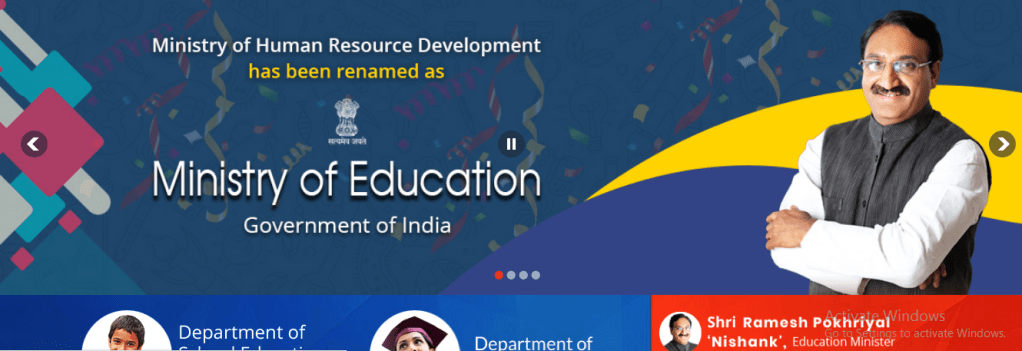
The Cabinet has also approved the renaming of the Ministry of Human Resource Development to the Ministry of Education.
NEP 2020 has been formulated after an unprecedented process of consultation that involved nearly over 2 lakh suggestions from 2.5 lakhs Gram Panchayats, 6600 Blocks, 6000 ULBs,676 Districts. The MHRD initiated an unprecedented collaborative, inclusive, and highly participatory consultation process from January 2015.
In May 2016, ‘Committee for Evolution of the New Education Policy’ under the Chairmanship of Late Shri T.SR. Subramanian, Former Cabinet Secretary, submitted its report. Based on this, the Ministry prepared ‘Some Inputs for the Draft National Education Policy, 2016’.
In June 2017 a Committee for the Draft National Education Policy’ was constituted under the Chairmanship of eminent scientist Dr. K. Kasturirangan, which submitted the Draft National Education Policy, 2019 to the Hon’ble Human Resource Development Minister on 31st May, 2019. The Draft National Education Policy 2019 was uploaded on MHRD’s website and at ‘MyGov Innovate’ portal eliciting views/suggestions/comments of stakeholders,including public.
AIM-
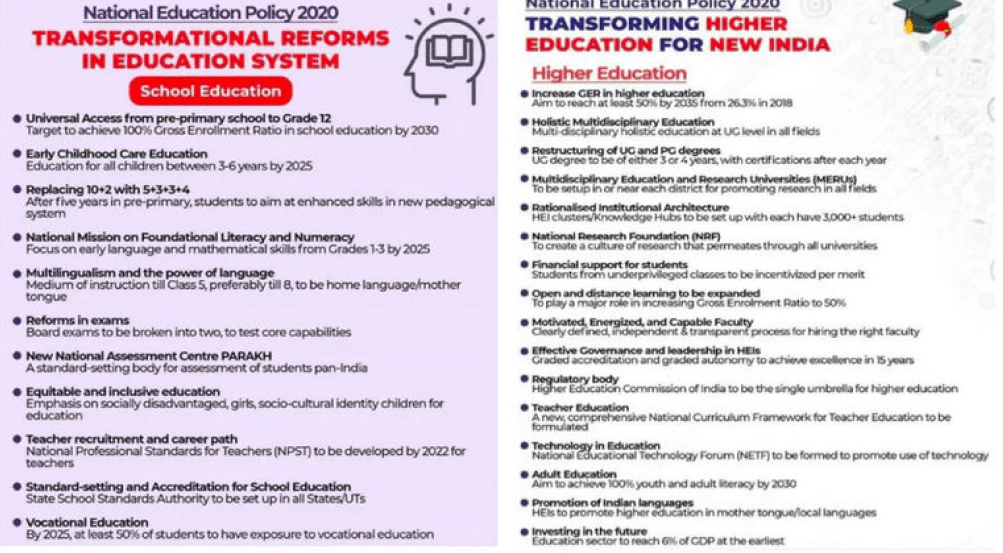
The aim of the policy is to create an education system that contributes directly to transforming the country, providing high-quality education to all, and making India a global knowledge superpower.
It aims for an inclusive & equitable Education System by 2030 and to achieve 100 per cent youth and adult literacy in India. It aims to increase the public investment in the Education sector to reach 6% of GDP at the earliest. It also talks about universalization of education from preschool to secondary level with 100% Gross Enrolment Ratio (GER) in school education by 2030 and bringing 2 crore out of school children back into the mainstream through an open schooling system.
The current 10+2 system to be replaced by a new 5+3+3+4 curricular structure corresponding to ages 3-8, 8-11, 11-14, and 14-18 years respectively.
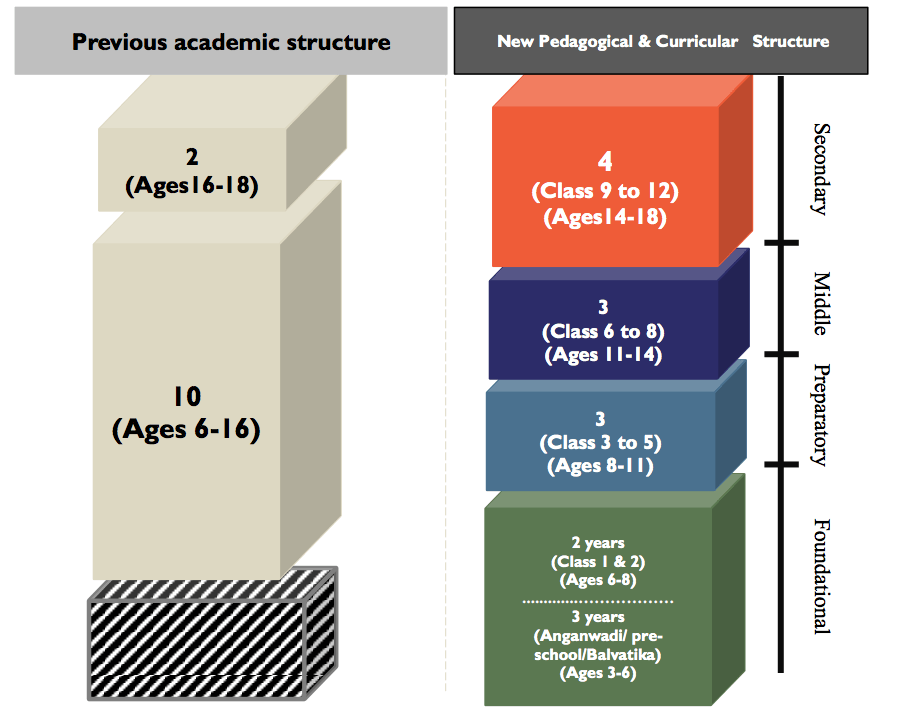
It will bring the uncovered age group of 3-6 years under school curriculum, which has been recognized globally as the crucial stage for development of mental faculties of a child. It will also have 12 years of schooling with three years of Anganwadi/ pre schooling.
Class 10 and 12 board examinations to be made easier, to test core competencies rather than memorized facts, with all students allowed to take the exam twice.
School governance is set to change, with a new accreditation framework and an independent authority to regulate both public and private schools.
Emphasis on Foundational Literacy and Numeracy, no rigid separation between academic streams, extracurricular, vocational streams in schools.
Vocational Education to start from Class 6 with Internships.
Teaching up to at least Grade 5 to be in mother tongue/regional language. No language will be imposed on any student.
Assessment reforms with 360 degree Holistic Progress Card, tracking Student Progress for achieving Learning Outcomes
A new and comprehensive National Curriculum Framework for Teacher Education (NCFTE) 2021 will be formulated by the National Council for Teacher Education (NCTE) in consultation with National Council of Educational Research and Training (NCERT).
By 2030, the minimum degree qualification for teaching will be a 4-year integrated B.Ed. degree.
Higher Education:
Gross Enrolment Ratio in higher education to be raised to 50% by 2035. Also, 3.5 crore seats to be added in higher education.
The current Gross Enrolment Ratio (GER) in higher education is 26.3%.
Holistic Undergraduate education with a flexible curriculum can be of 3 or 4 years with multiple exit options and appropriate certification within this period.
M.Phil courses will be discontinued and all the courses at undergraduate, postgraduate and PhD level will now be interdisciplinary.
Academic Bank of Credits to be established to facilitate Transfer of Credits.
Multidisciplinary Education and Research Universities (MERUs), at par with IITs, IIMs, to be set up as models of best multidisciplinary education of global standards in the country.
The National Research Foundation will be created as an apex body for fostering a strong research culture and building research capacity across higher education.
Higher Education Commission of India (HECI) will be set up as a single umbrella body for the entire higher education, excluding medical and legal education. Public and private higher education institutions will be governed by the same set of norms for regulation, accreditation and academic standards. Also, HECI will be having four independent verticals namely,
National Higher Education Regulatory Council (NHERC) for regulation,
General Education Council (GEC) for standard setting,
Higher Education Grants Council (HEGC) for funding,
National Accreditation Council (NAC) for accreditation.
Affiliation of colleges is to be phased out in 15 years and a stage-wise mechanism to be established for granting graded autonomy to colleges.Over a period of time, every college is expected to develop into either an autonomous degree-granting College, or a constituent college of a university.
CRITICAL ANALYSIS
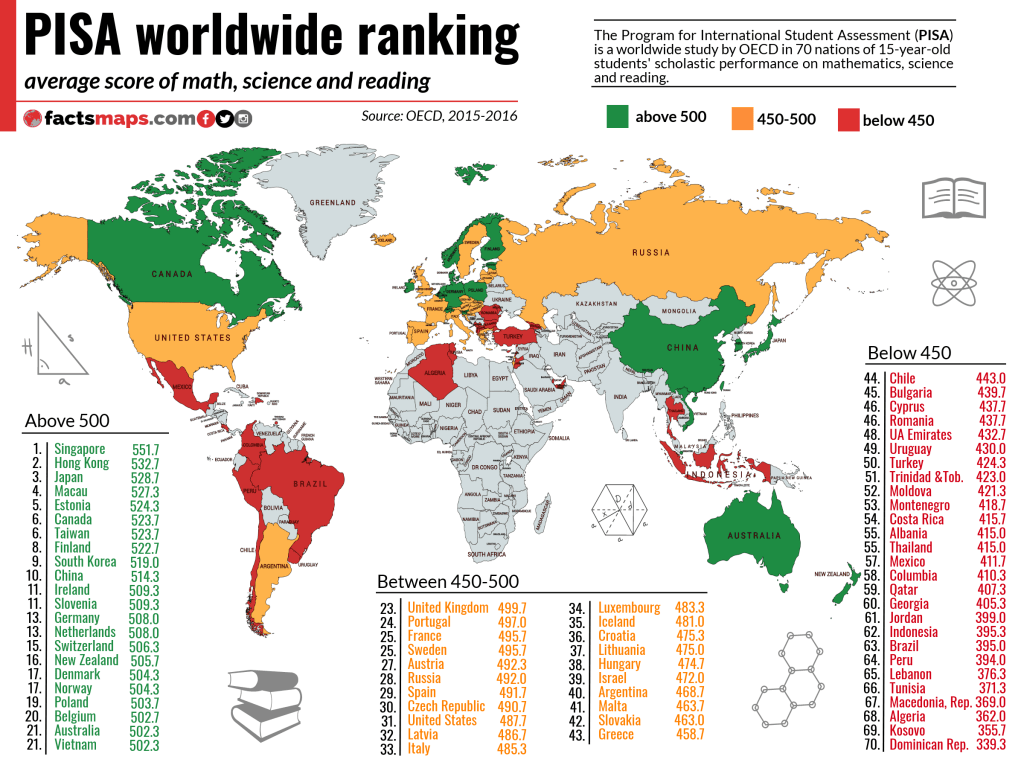
The New Education Policy is an inclusive, participatory and holistic approach, which takes into consideration field experiences, empirical research, stakeholder feedback, as well as lessons learned from best practices. It is a welcome move amidst the pandemic where education has been drastically affected. It tries to bring the preschool within the ambit of education because in spite of charging exorbent amount of fess there was no proper focus on the curriculum. Also ranking of India in the ASER & PISA REPORT was very poor, but this new education policy would surely help in changing this perspective provided the implementation of the same goes right.
The concept which is a little problematic from my perspective is MULTILINGUALISM. What about people in government jobs in which they have to face frequent transfers? How will a child from north India would cope with the local language of a district or territory in south? Although the policy says that the teacher should try to keep it bilingual but there is always a caveat, south Indian teacher teaching in Hindi is a way forward concept. The NEP doesn’t say anything specifically on children of parents with transferable jobs, but acknowledges children living in multilingual families: “Teachers will be encouraged to use a bilingual approach, including bilingual teaching-learning materials, with those students whose home language may be different from the medium of instruction.”
Also too many teacher training programs is a bit confusing activity. I feel that instead of creating a synergy they are creating confusion. There should be uniform training programs and a professional training standard as far as testing of teachers is concerned.
Inviting the foreign universities for opening their campus in India is a welcome step. There would be a sense of competition which would further encourage the Indian educational institutions to work more on their system and curriculum, a race for being the best which would indirectly benefit our students.
The Centre has aimed to surge public spending on education to almost 6 percent of Gross Domestic Product (GDP), i.e. a nearly 2 per cent increase in spending. In the last 6 years, ModiGovt expenditure in education has declined in real terms, this might question the validity of this highly aspirational step. Also, we need to ensure that people who are dropping out of the earlier stages of education are not doing so because they don’t have resources.
The biggest area where this policy is lacking is explicit information on funding and fees. If we have a policy that ends up driving up the cost, we will reduce opportunities and make education unaffordable for the poor. It requires closer scrutiny, in terms of its implications for the marginalized, disciplinary spaces, autonomy, and constitutional values, among other things. What are its implications for the majority of those covered under the acronym SEDGs (Socially and Economically Disadvantaged Groups) in the text? Also absent is any mention of reservation in academic institutions, whether for students, teachers, or other employees. Reservation, necessary but not sufficient, is the bare minimum required in terms of affirmative action in the highly differentiated socio-economic milieu in which we exist. The silence of the document on this issue is troubling, to say the least.
There are some good elements to the NEP 2020 that will generate little friction, and need only adequate resourcing. Provision of an energy-filled breakfast, in addition to the nutritious mid-day meal, to help children achieve better learning outcomes, is one. Creation of ‘inclusion funds’ to help socially and educationally disadvantaged children pursue education is another. Where the policy fails to show rigor, however, is on universalisation of access, both in schools and higher education; the Right to Education needs specific measures to succeed. Moreover, fee regulations exist in some States even now, but the regulatory process is unable to rein in profiteering in the form of unaccounted donations. The idea of a National Higher Education Regulatory Council as an apex control organization is bound to be resented by States. Similarly, a national body for aptitude tests would have to convince the States of its merits. Among the many imperatives, the deadline to achieve universal literacy and numeracy by 2025 should be a top priority as a goal that will crucially determine progress at higher levels.
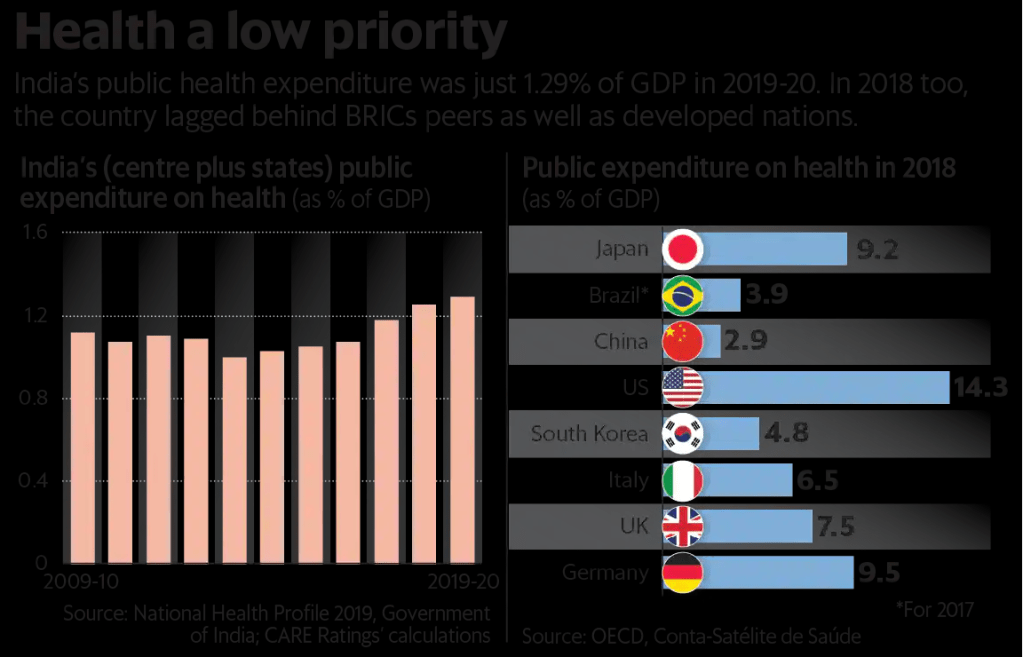
India’s economy needs big dose of health spending
INDIA’S EXPENDITURE IN HEALTH CARE IS AROUND 1.8% OF GDP. SO WE NEED TO INVEST MORE ON OUR HEALTH CARE SYSTEMS, BECAUSE NO MATTER HOW GOOD A POLICY YOU MAKE, IT’S ALL WORTHLESS IF THE PEOPLE IN YOUR SOCIETY ARE NOT HEALTHY.
Thus we can say that how far does this policy goes as far as its implementation is concerned is the most disquiet part. But we will come to know better once the implementation begins, as we all know that THE DEVIL LIES IN THE DETAILS.
ARCHIT SRIVASTAVA
STUDENT
INDIAN & WORLD POLITICS


Well done bro !
LikeLike
Merci!!
LikeLike
In my knowledge the last change in the education system of India that is RIGHT TO EDUCATION, under article 21(A).
And after that these major changes, in my opinion this is revolution for Indian education system .
And I like what you write keep doing
Best of luck 🤞
LikeLiked by 1 person
Thanks for the gesture bhai!! Cheers!
LikeLike