
Introduction:
In a significant development for the Indian financial sector, Housing Development Finance Corporation (HDFC) Ltd. has merged with its subsidiary, HDFC Bank, through a reverse merger. The proposal for amalgamation was approved by the respective boards of directors, signifying the cessation of HDFC Ltd. and the creation of a stronger combined entity. This blog aims to provide insights into the implications of this merger on the Indian stock market.
Change in Market Cap:
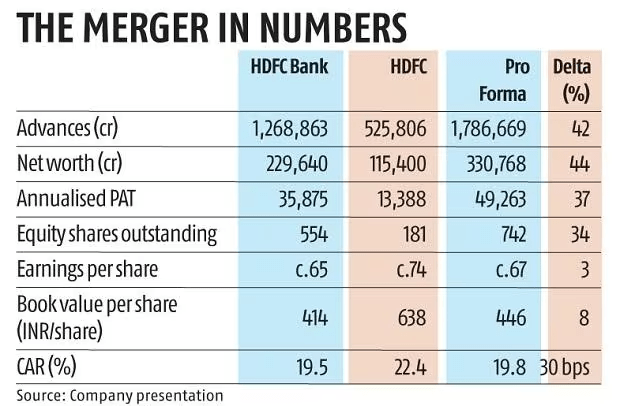
Following the merger, HDFC Bank’s market capitalization is set to increase substantially. As of the last trading session, HDFC Bank had a market cap of ₹9,51,584.36 crore, while HDFC Ltd. stood at ₹5,22,368.64 crore. With the merger, the joint market cap of HDFC Bank is projected to reach ₹14,73,953 crore, surpassing Tata Consultancy Services (TCS). Consequently, HDFC Bank will become the second most valuable Indian company in terms of market capitalization, trailing only Reliance Industries Ltd. (RIL).
Weightage in Nifty Index:
The merger will also result in a significant change in the weightage of HDFC Bank within the Nifty index. Currently, HDFC Bank contributes 9.23%, and HDFC contributes 6.16%, combining to a total of 15.39% weight in the Nifty index. Post-merger, the relative weight of HDFC Bank will be around 15%, implying that Reliance Industries, which presently holds approximately 10% weight, will no longer remain the most dominant stock in the Nifty index.
Becoming the Fourth Largest Bank in the World:
The merger of HDFC Bank and HDFC positions the newly formed entity as the world’s fourth-largest bank, following JP Morgan Chase & Co, Industrial and Commercial Bank of China Ltd (ICBC), and Bank of America Corp. This achievement showcases the growing strength and influence of Indian financial institutions on a global scale.
Merger Ratio:
The merger ratio for HDFC Bank and HDFC is set at 25:42. This means that for every 25 shares of HDFC Ltd., shareholders will receive 42 shares of HDFC Bank. The deal ensures that HDFC Bank will be entirely owned by public shareholders, while existing HDFC Ltd. shareholders will own a 41% stake in HDFC Bank.
Impact on HDFC Bank Subsidiaries:
As a result of the merger, several prominent subsidiaries of HDFC Bank, including HDFC Securities, HDFC AMC, HDFC Ergo GIC, HDFC Capital Advisors, and HDFC Life Insurance, will become integral parts of the bank. Any significant developments within these subsidiaries may subsequently affect the share price of HDFC Bank following the merger.
Loan Portfolio Composition:
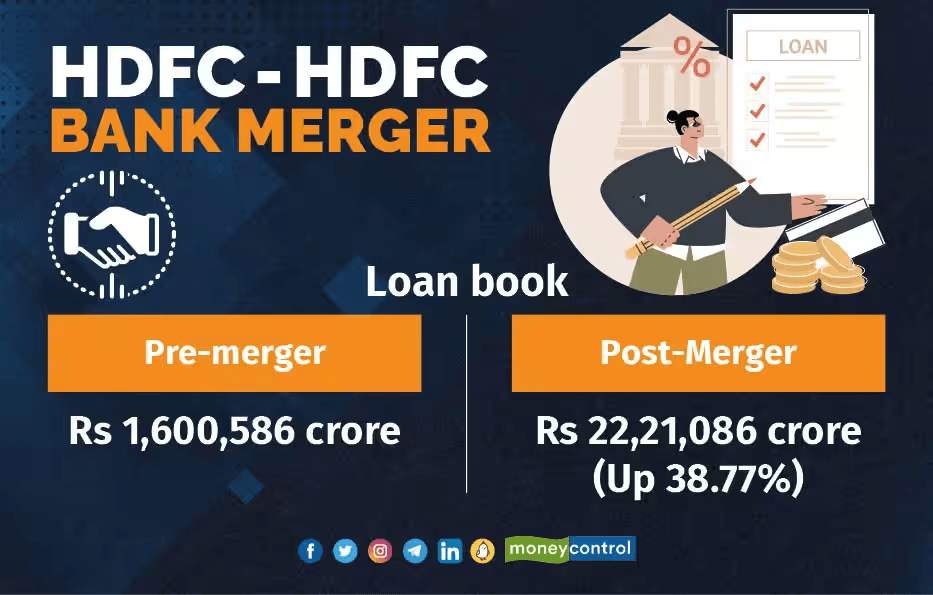
The merged entity will witness a diversified loan portfolio. Post-merger, HDFC Bank has become the second-largest bank in India in terms of credit, following State Bank of India. Mortgages are expected to comprise over 30% of the portfolio, while loans from commercial and rural banking sectors will account for around 25%. Retail loans will contribute more than 20%, with corporate loan books and other loans making up 20% and 5% respectively. This diversified loan portfolio reflects the strengthened position of the merged entity in catering to various sectors of the economy.
Conclusion:
The merger between HDFC Bank and HDFC heralds a transformative event for the Indian stock market. With a projected market capitalization surpassing other major companies, increased weight in the Nifty index, and the creation of the fourth-largest bank in the world, the impact of this merger is substantial. It is expected to generate significant synergies and strengthen HDFC Bank’s risk profile. As the Indian financial landscape evolves, all eyes will be on the new entity as it navigates the opportunities and challenges that lie ahead.
KUMAR-ARCHIT
INTERNATIONAL BUSINESS & FINANCE
 WP REPUBLIC