WELCOME BACK GUYS TO WP REPUBLIC.
I would like to welcome you all and let you know that I appreciate you, spending time here at the blog, very much. Everyone is so busy, and life moves fast, so I really do appreciate you taking time out of your busy day to check out my blog! Thanks.
Another thing I will always appreciate is your feedback to the blog. If you have any comments or suggestions, I welcome them and would love to hear them, always. Not that all criticism is a fun thing, but I think a criticism provided in an honest positive manner is something we can all learn and grow from, if we are open to hearing it. I will always listen to your ideas. So, I welcome your suggestions for the blog, and guys, one more thing that I would like to add is PLEASE DON’T FORGET TO PRESS THE LIKE OR DISLIKE BUTTON.I would like to make it clear that the intention behind writing this blog is academic knowledge and bringing clarity to same. Credit goes to the articles, editorials and lectures of various teachers which I have gone through to have clarity on this topic.
CONCERNED ISSUE- THE SABRIMALA CASE STUDY
The history of framing of the constitution is a history of conflict and clashing philosophies. The constitution’s fundamental rights chapter grants rights to individuals against the state to individual against other individual to group communities against the state, and as a final layer, allows the state to restrict their rights for various regions

Tension between their various provisions is inevitable, and is perhaps reflected most starkly in the religious freedom clause Article 25 and 26. Article 25 (1) guarantee to all person the right to freely profess, practice, and propagate their religion. Article 26(2) grant to religious denomination the rights to manage their own affair in the matter of religion. Now over riding both their provison. Article 25 (2) allows state intervention in religious practice, if it is for the purpose of “social welfare”.
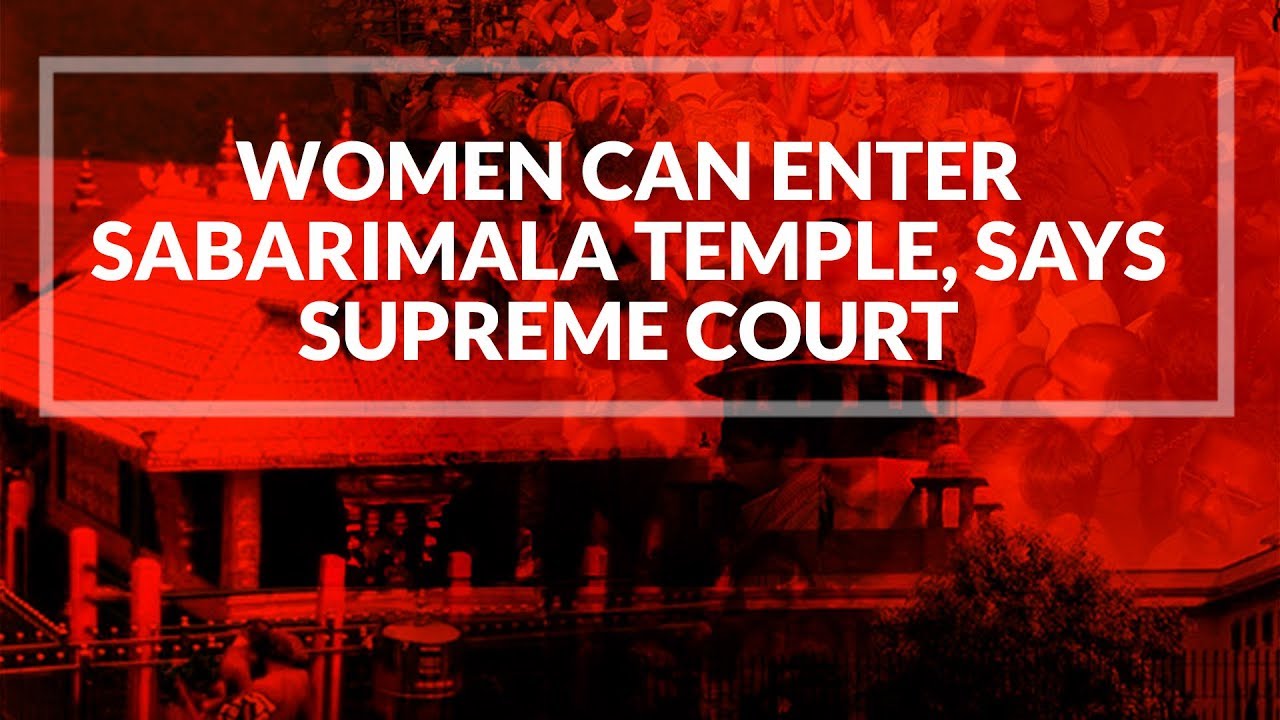
Kerala’s Sabrimala temple issue is about the conflict between women rights and fraction. According to old age tradition and customs,women from 10 to 50 years of age were not permitted into Sabrimala temple, because of strict celibate status of load Ayyappa. The question was that can the code or government interfere in essential practice of a religion and that too with India being a secular country. There was a question on constitutional morality. Things changed when on September 28 2018 ,the constitutional bench of the Supreme Court, declared that restricting entry of women of menstruating age was unconstitutional. By the majority of 4:1 the court struck down the provision of the Kerala Hindu places of public worship rules. The one judge against this verdict was justice Indu Mehlotra who was heavily criticized for speaking against female rights and that too after being a female. The point of Sabrimala group was that since they declared themselves to form a denomination, so they should be allowed to make their own rules. The Supreme Court said that Ayyappa devotion do not constitute a separate religious denomination. The Supreme Court clearly said that prohibition on women is not an essential part of Hindu religion. Secondly individual freedom prevails over professed group rights in the matter of religion. The court also said that not allowing women because of menstruation is based on notion of impurity which is a form of untouchability. So the Sabrimala group could neither prove that banning women is part of a essential practice in Hindu culture nor that their group is a separate religious denomination. So it is impossible for the court to give you protection under Article 25 of the constitution.

Although one can say that comparing women discrimination with untouchability can be a little problematic, on the part of the court as punishment are severe in case of untouchability . A person having practice or essential religious practice is for the religious community to decide and not for the court. Infact Justice Indu Mehlotra who was the lone member against this verdict ,said that the present judgment would not be limited to Sabrimala ,but will also have wide ramification and issues of deep religious sentiment should not be ordinarily interpreted into by the court or the state . This verdict of 2018 was reveled in 2019 as various question were still to be answered by the court .
The first question was whether the definition of the essential religious practice be decided by the court or should the question be left to the respective religious head secondly should “essential religious practices” be afforded constitutional protection under Article 26 which talked about freedom to manage religious affairs. The term essential religious practice is clearly defined in the doctrine evolved by the court in 1950’s which is practices and beliefs considered integral by a religious community are to be regarded as essential and protected under Article 25. Thirdly the court needs to decide that what is the permissible extent of judicial recognition a court should give to PIL’s filed by people who do not belong to the religion of which practices are under scanner.
Recently the Supreme Court had said that it has full power to take up any matter to do complete justice, explaining why it was referred to a larger bench as it decided to examine larger issues of religious freedom across multiple faiths in connection to the Sabrimala review. (Article 142)
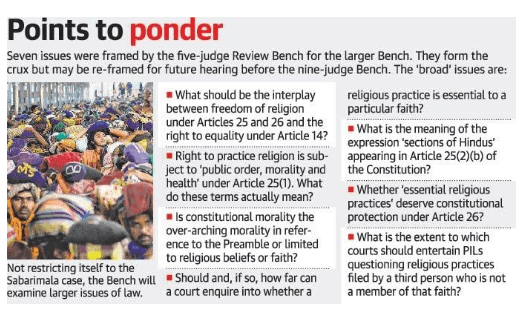
So one can say that it is a clear cut conflict between constitutional morality and essential religious practices. One does not find the exact definition of constitutional morality. Justice Deepak Mishra tried to define this term during his verdict on Section377 case. He said that morality is not yours or mine, something which is based on constitutional values is constitutional morality. He said that constitutional morality does not include only provisions of the constitution. Its scope is a little beyond that, so that it ensures that you have an advanced, pluralistic and inclusive society.
CONCLUSION
This issue is an excellent opportunity for the court to reassess and reform the age old traditions in the country which discriminate certain sections of the society. The court should look beyond just denied of freedom of religion to women but also of equal access to public space. It will put the foundation stone for the radical re reading of the constitutions and can help the court to make a meaningful difference to people civil rights across caste class gender and religion.
In this era of 21st Century where on one hand we talk about development, growth, prosperity, global leader and world power, on the other hand, we are still tied with the chains of our deep-rooted conservative ideologies of certain customs and beliefs and hence fail as a society and a nation.
The women in the society are discriminated on grounds of gender and sex and they are still considered submissive to men due to the patriarchal mindset of the people at large. The movements of feminism have come a long way in ensuring and giving rights to the women but we still have a long way to go. India being a country of diverse people and culture, the area of religion is a sensitive topic to touch upon. The Supreme Court through its judgment cleared the tussle between fundamental rights and traditions. Traditions have always been an important and essential part of our society and it is one of the famous things for which the country holds its identity. But traditions which hamper the basic essence of the constitution and rights of a particular class of people in the society due to mere natural biological process certainly needs to be questioned. The Constitution of India guarantees certain fundamental rights to all the citizens wherein Right to Equality and Right to Religion are two of them. The Supreme Court through its verdict of removing the ban on women from entering the Sabarimala temple again established the supremacy of Constitution above all other aspects and ensuring that the rights of women are not violated due to certain long-prevailing customs and traditions.
ARCHIT SRIVASTAV
STUDENT
INDIAN&WORLD POLITICS
 WP REPUBLIC
Good
LikeLike
🙏👍❤
LikeLike
✌✌✌
LikeLike